- What does an Uber© Cooperative Property consist of?
- Standardization to Guarantee.
- Integrity and protection of drivers
- SOCIAL
- VISION and DIGITAL USE
- INCENTIVE & SCORING
- TRUE COMPETITION, MONOPOLY and FALSE MARKETS
- FACILITATIONS for some CUSTOMERS
- AVOID INFAMIES!
- EFFICIENCY
- Links added after the article was published
Yes! 3 Times Yes! Yes, it is indeed necessary for the City, the Polis (in the sense of a dense residential area and presence of inhabitants) to transform the Uber© Type services into a service, not only controlled by the Community, but also owned by the same Community. Yes, it is possible to make this transformation in our present world. And yes, it is possible to do it now. There is absolutely no fatality in allowing the uncontrolled and damaging effects on the Community of a development driven by short-term interests and ultimately reserved for a handful of people (General Management and the owners of shares) to develop.
Before getting to the heart of the matter, let’s recall that the primordial subject is the economic, social and ecological optimization of the organization of individual travel in dense urban areas. The subject of public transport is obviously another subject. It is, moreover, a frontier of the subject under study. The other frontier is individual travel, but made with means that also belong to these individuals and that (generally) transport only one person (even in a five-seater car…). These means can take different forms. It can be by private car, or by bicycle or scooter or skateboard or even on foot. The other form in the middle of these two borders is thus the organization of transport of individuals in vehicles that are not on fixed and recurrent routes (bus, metro, streetcar…) and that do not belong to the persons transported. In this type of transport (as a reminder, in dense or even very dense urban areas such as country capitals or large regional or tourist cities), we find, without being exhaustive, the following types of transport :
- First, residents who structurally do not have a vehicle in the city and for whom, for x or y reasons (not necessarily relevant or good), the public transit offer does not meet their needs. Or tastes.
- Then the residents who exceptionally (breakdown, change of vehicle, loan …) will not have a vehicle.
- For people who do not live in the urban area and who came without individual means of transportation. Or who left it on the outskirts of the area.
- For people who have to travel in areas where private cars are not allowed or where there is no public transportation. This is the case in particular for limited traffic zones (ZTL) in Italy. Or the case of city centers with urban tolls such as London.
- People with a large or heavy load that is difficult to manage in public transportation. This may be the case when buying a bulky good or when doing bulky food shopping.
- People with temporary or permanent health difficulties for whom walking to a public transportation station, waiting, standing, and returning under the same conditions is very difficult.
- Tourists arriving at public transportation terminals such as airports, train stations, bus stations or port stations.
The existence of individual transport managed by means other than collective transport therefore has many uses and purposes. Consequently, this production of services should be organized in the best interests of the Community and its members. This obviously includes the customers, but also the producers of the service, the drivers. Once all the dimensions of this type of service are well understood and described, the necessary forms of control over the production of this service can then be put in place.
But, whatever the forms of control by the Community, the heart of the matter is now the description of the advantages of this suppression of Private service and its replacement. It consists of 9 main Themes. Here they are, without necessarily being in order of priority, because depending on the place and time of the implementation of the COOPERATIVE GOOD service of individual transport [and this isnot an oxymoron 🙂 ] the importance of the themes will be particular to each deployment.
What does an Uber© Cooperative Property consist of?
But first of all, before moving on to the 9 themes, we will describe the 6 points of what a COOPERATIVE individual transport good is. – All Taxi or VTC drivers are attached to the same structure. – This structure has a monopoly on individual trips. – This structure is controlled by the Community (see above). – The tariffs are controlled and known by all (Drivers and Customers). – The individual transport service is available through a specific Mobile Application and/or a website allowing reservations and/or orders to be made in real time. – The payment is first received by the COOPERATIVE GOODS organization. It is up to it to define the modalities (total or partial, immediate or not, structure fees…) for the reversal of the transaction paid by the customer.
We can now return to the 9 themes announced above.
Standardization to Guarantee.

- Guarantee the minimum capacity of the Drivers.
- The service of the Cooperative Good makes sure that all “producers” have a driver’s license (this seems obvious, but many cases of private “drivers” have been reported as not having their driver’s license. Whether they never had or had a suspended license).
- The Cooperative Good service ensures that drivers are always fit to drive with regular and planned capacity tests [reflexes, quality of vision, knowledge of the highway code (the modalities of this test are totally variable according to the city-country where the service is deployed)]. And also surprise examinations to identify (and sanction) drivers with potentially dangerous behavior following the absorption of illegal substances (Drugs). Or legal (Alcohol), but in quantities greater than the legislation in force. Or dangerous behavior or driving style. This helps to reassure customers about the qualities of the drivers and the service ordered.
- This may come as a surprise to some, but the objective is to ensure that the driver is the driver 🙁 indeed, there have been many cases where the drivers of the vehicles were not in fact the licensed drivers. The “official” drivers being replaced by accomplices and comparses. Certainly for economic reasons. According to Transport of London, an organization responsible for supervising cab services, among other things, more than 14,000 trips were made in London with “fake” drivers. See article in the Guardian .
- This will also ensure that the Driver is not at his twenty-third hour of work in a single day. And that he possesses a state of freshness and vigilance necessary for the good exercise of his activity of transporting Human Souls…
- Guarantee Quality of Service.
- In addition to the minimum capacities to be obtained, it is possible to retain or authorize only the Drivers with the best results in the different exams.
- Or make a selection on criteria other than purely driving criteria such as :
- Knowledge, without GPS, of route optimization according to driving hours and days. Indeed, globally, the interest of the Community is that its members are transported as quickly as possible from point A to point B. This allows other people, with their own cars or on public transport, to go as fast as possible (fluidity brings fluidity). Not to mention the reduced energy consumption and impact on air quality.
- Cultural knowledge of the city. Some cities, but not only those that are very touristy, could also select drivers based on their ability to present the historical (and current: current cultural events) assets of the city when travelling. It is not necessarily a question of serving as a tourist guide (although this could also be the case depending on the choice of the city), but of highlighting on the route, without making detours (unless expressly requested by the client), the various remarkable points seen on the route. It is also possible to imagine 2 categories of drivers clearly identified at the time of booking for the client, with a normal route and another with “cultural” comments, which also implies a difference in cost (identified in advance) between these two services.
- Quality of the reception of the customer. We can also select the best drivers with a sense of contact and customer relations in order to ensure the best possible service for normal (neither arrogant nor obnoxious) customers.
- Quality of conduct and compliance with regulations. Supervision and control of performance [see chapter on INTEGRITY-PROTECTION] with guaranteed minimum income will avoid financial pressures that lead drivers to drive fast, very fast, too fast, and/or not comply with local traffic laws. This will lead to greater safety. First for the passengers :-). Then for the Driver. And also for the passengers and drivers of the other cars. Not forgetting the pedestrians. 🙂
- To guarantee protection to customers.
- In particular by the possession of up-to-date and sufficient Insurance. Please note that the COOPERATIVE PROPERTY can also take care of the totality of the Insurance of the drivers by negotiating a wholesale price for this protection. It is up to the decision-makers of the COOPERATIVE PROPERTY to pass on the cost of the Insurance to the drivers (per year, per quarter, per month) or to include this cost in each trip transaction.
- To guarantee a Quality of means.
- It takes more than just the quality of the drivers. But also the quality of the vehicles. The COOPERATIVE PROPERTY guarantees that the authorized vehicles comply with the standards in force (technical control OK. Even a specific technical control).
- We can also go further in the quality of the vehicles offered by two complementary approaches.
- Allow only vehicles that meet certain standards:
- Level of pollution (CO² emission, …)
- Type of propulsion (no diesel, hybrid at least, or electric only)
- Quality of the interior of the vehicle (Seats available)
- Displacement quality (Active suspension system, hydropneumatic, seat quality…)
- Make the COOPERATIVE PROPERTY the owner of the vehicles. Whether it is a part of the fleet or its totality. This guarantees, potentially, the quality of the vehicles and their regular and preventive renewals.
- This also allows the COOPERATIVE PROPERTY to allocate, temporarily, on its own criteria, this or that vehicle to this or that driver. This can give a driver a boost by lending him a more “luxurious” or larger than average vehicle to help him be selected by potential customers.
- Allow only vehicles that meet certain standards:
- Guarantee an ethical service.
- The form of COOPERATIVE GOOD makes it easier to avoid all forms of racial, social, sexual and gender discrimination through awareness and training for drivers. But also by the exclusion from the service of drivers who do not have the expected ethical behavior. We will see in Integrity-Protection that this is also expected from the clients].
- The COOPERATIVE PROPERTY allows to avoid billing slippages for customers. Examples of such cases on private VTC services are numerous. The Cooperative Property allows a possible, easy and identified recourse to a refund in case of possible abuse. Or can also prevent abuse by asking the customer, via the application, during the trip, for confirmation that a certain billing amount has been exceeded. This can be an extra layer of verification and protection. In the absence of express customer consent (typing a specific code in the application, for example), the COOPERATIVE PROPERTY operating rule will require the driver to stop the service. Or to bring the customer back to a particular point.
Integrity and protection of drivers
Customer protection is necessary. And it will be best guaranteed by the CO-OPERATIVE GOOD. But it must also be accompanied by the protection of the Drivers. And especially traditional drivers such as cab drivers. One of the advantages (perhaps the only one?) of the exercise (temporary, let’s hope) of these forms of Private Driver was to validate that new actors (VTC) in addition to traditional drivers (authorized Taxi) could increase the Service Offer without definitively eliminating (at least for the moment?) the traditional drivers. And that in some cities, the notion of Taxi Monopoly granted to private companies (These companies are not the new entrants on this market like UBER© type companies. We will call these companies already present on the market, the classic or old Private companies), with entry barriers, was not relevant for consumers. The arrival of new “players” in the form of “independent” VTC drivers gave a big breath of fresh air in some cities. And allowed some people, blocked or dissatisfied with their jobs, to start a new business. Even if this one involved a lot of luring and disappointment in the long run. For this reason, it is necessary to keep this spirit of openness to newcomers in this type of service while keeping the previous social protections. Or at least keeping the overall spirit of social protection. Because the forms of this protection will necessarily be different depending on where the service is deployed.
First of all, we must therefore safeguard traditional players such as the cab drivers of the former Monopolies (classic private companies). This is the indispensable counterpart to the establishment of the COOPERATIVE GOOD. There must be a protection of the traditional drivers. According to the customs and habits, very often the exercise of the activity of “traditional” cab driver is subject to the (expensive) purchase of a license. The average cost of purchasing a license in Paris according to the sitehttps://www.ctt-taxi.fr/ is estimated at 115 000€. This does not include the cost of purchasing the vehicle. There are therefore individual strategies of commitment and financial risk-taking that must be understood, respected and guaranteed. Thus the implementation of the new CO-OPERATIVE PROPERTY system must be accompanied by the repayment, total or partial, of the remaining debts to be honored by the traditional Taxis. And at least for the payment-reimbursement of the activity authorization license part. One cannot create a New World without social and economic justice, leaving aside, without any consideration, the individual actors of the previous world. When it comes to companies, corporations or multinationals, the accompanying decisions will not necessarily be the same. For the priority of accompaniment, support and help is and will always be given to individuals.
- Always within the framework of this integrity and the protection of the actors, whether they come from the Old World (Taxi) or the New World (VTC), within the framework of the COOPERATIVE GOOD, the link of subordination between the instructing party and the employee will be well established. This point is probably more specific to French @preview legislation than in other countries. It allows the link between the cab driver and the holder of the COOPERATIVE PROPERTY to be clearly recognized. And the monopoly (see conditions above for the exercise of the COOPERATIVE GOOD) that is deployed, notably via the Application, and which “welds” the VTC and the individual transportation service. This recognition of a link will ensure social protection (see SOCIAL point) for drivers. And will put an end to the myth (to the pipe?) of the independent service platform @preview (Wired. In English). And drivers totally independent of these @preview structures. (In English).
- The COOPERATIVE PROPERTY will also guarantee the income owed to the drivers by the customers. In case of dispute, whether on the service provided or on the means of payment, the structure of the COOPERATIVE PROPERTY will be able to :
- Guarantee, in whole or in part, the disputed payment.
- Make a cash advance to the driver, in whole or in part, in order to regularize the current incident.
- Take charge, instead of the driver, of exceptional compensation to customers due to unforeseen circumstances not covered by the individual or group insurance of the driver(s).
- Provide legal assistance in case of specific litigation
- The COOPERATIVE PROPERTY will also be able to protect the Drivers by blocking the use of the service, legally and in accordance with the legislation in force, for customers who have already had reprehensible, illegal and/or incorrect behavior .
- Also, the visibility on the working hours of the actors allows to protect them by ensuring that maximum limits (variables according to each COOPERATIVE PROPERTY) are not exceeded.
- Update of March 18, 2020. Still in the context of protecting drivers, a COOPERATIVE PROPERTY, allows to protect them from false accusations of bad payers. Indeed, a detestable attitude seems to have spread among some abusive consumers, accusing VTC drivers of drinking alcohol or taking drugs. Since the policy of the VTC groups is not to tolerate (rightly) these behaviors, they make an almost automatic refund of the paid trip. Reimbursement which of course prevents the cab from being paid. This takes away the fruit of their efforts. But also, these false accusations lead to the suspension, sometimes definitive, of activity of the unjustly accused drivers! The economic loss is then total. Plus the social loss with an unjustly degraded image. The functioning of a COOPERATIVE GOOD which is not oriented and centered on the only financial benefit allows the existence of listening to the defense of the concerned drivers. As well as the pooling of a file of doubtful consumers between all the COOPERATIVE GOODS of transport (in the respect of the local Laws and of the notions of confidentiality and access of rectification).
SOCIAL

Also for the actors of the service, the social part will be better ensured with an organization and a structuring of the COOPERATIVE type. This will allow the implementation of Minimas on many levels:
- A minimum of economic remuneration for the drivers.
- This minimum may come from the margin compression of the organizers of the COOPERATIVE PROPERTY who are not placed in an absolute logic of huge profits or stock market performance. This in turn makes it possible to better pay the real players in the service.
- Or an equalization – distribution of the incomes of all the drivers who are bounded up and down to guarantee a minimum hourly wage to any actor of the service.
- Or a complement coming from the holders (City, Community…) of the COOPERATIVE GOOD who pay back to the drivers a part of other revenues (municipal taxes…).
- A minimum of social conditions such as :
- Decent schedules (see above)
- Paid vacation days
- Real pensions
- Effective and affordable health protection
- Transparency on incentives and bonuses. More or less subtly, the holders and defendants of today’s new private services are modifying the conditions of remuneration of the players to encourage and force them to change their behaviour, and ultimately, to work more for less money.
- Monthly smoothing of revenues in tourist areas with concentrated seasonality. For some of these types of cities, there are two, or even one, quarters of real activity intensity in individual transportation. A COOPERATIVE asset is perfectly capable (if it is decided or voted) of smoothing the revenues paid over the year to the actors to enable them to always have sufficient income to pay loan repayment charges (professional vehicle or simply buying a house or apartment) without them being in financial difficulty with their banks. This ensures serenity to the greatest number. Including “bankers” :-)]. And Serenity is also a COMMON good!
- And compared to the old classic cab companies (private companies before the invention of the Internet, delegated public service, …) the COOPERATIVE GOOD will allow new actors to enter this market much more easily, and at a lower economic cost, than in previous organizations. Indeed, very often the exercise of the right to operate a conventional cab was regulated by the possession of a license which was purchased on a closed and not very transparent market (see above). Or else, it was already subject to the sole will and control of a single economic actor. The existence of truly independent conventional cabs was most often found in “small” towns.
VISION and DIGITAL USE
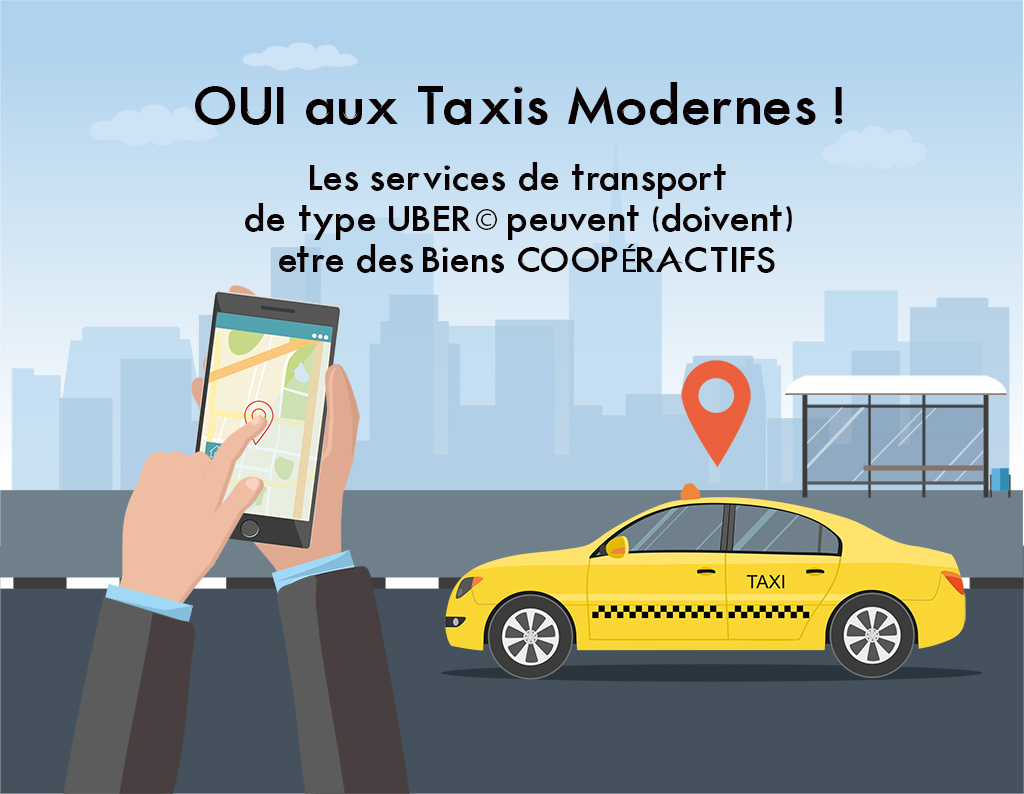
The COOPERATIVE COMMON GOOD having the Activity Monopoly, as described at the beginning of the article, it also has, and obligatorily, a Mobile Application and a Website. These Digital supports will allow to collect, in full transparency towards the users (Drivers and Customers), precise data [it is necessary to know, at a given time, who made which route and how much he paid :-)] and anonymous data. If the precise data are intended to be used, above all; for the financial part, the anonymous data are intended to be used for :
- Know the types of journeys made.
- What is the most frequent route?
- What are the peak and off-peak times? ==> Driver attendance scheduling?
- What is the average distance of a trip?
- What is the average price of a ride?
- What are the most remunerative trips for drivers between structural costs (car depreciation, maintenance, energy…) and invoicing? Airport – City center ? Shopping Center – Cultural Center ? This knowledge of “attractive” routes will allow the COOPERATIVE PROPERTY to possibly rotate among the drivers assigned to these routes in order to distribute the available “manna” as well as possible.
- What are the structuring differences between the journeys made during the working days of a week, those of the “weekend”, those of the school vacations (very French case 😉 ), those of the big holidays, of the big events?
- Make this anonymized information known, in whole or in part, through the Open DATA. Either in a Universal way. Or restricted to the country of the COOPERATIVE Good.
- To share part of this vision with the users of the Service. If only for the Application – Website part for online booking or ordering.
- To make this vision evolve by following, as much as possible, the ergonomic and interface evolutions to facilitate the service to customers and drivers.
This information will be made available to the internal actors concerned (Drivers) through dashboards in a specific application. These dashboards will allow them, among other things, to compare their activities and the average of their other colleagues. Or simply to see their performance. And compare them from day to day, week to week, month to month or over different years.
INCENTIVE & SCORING
As a reminder, working in a COOPERATIVE COMMON GOOD does not mean letting others work, doing nothing and still have an income. There is a strong, and mandatory, link between the individual’s performance and his level of remuneration. However, and this is one of the differences with capitalism, this link is weighted and framed. Framed so that the actor’s production of the COOPERATIVE GOOD is oriented towards the preservation and reproduction of the Good in question. And weighted so that the notion of “The winner takes all @preview” does not exist by limiting both the ceiling and the floor of revenues. And within the framework of this spirit of empowerment of the actor, for this type of COOPERATIVE Good, the Rating of the drivers’ performances by the customers is a decisive element. This will make the Drivers responsible for the performance of their services. In turn, customers will be able to make their choices with full knowledge of the facts. The application or website of the COOPERATIVE GOODS will therefore have the functionalities that have now become classic for this type of service, namely :
- Rating by a scoring system or stars of the overall performance of the driver.
- Possibility to leave comments on the performance (strong points, weak points).
- Possibility to rate parts of the service such as: punctuality, state of the vehicle, reception, efficiency of the trip.
You will also find the features expected for customers such as :
- Order in real time with “call for tenders” (framed price on the minimum) and selection of offers or availability of drivers.
- Advanced reservation of the trips.
- “Subscriptions” to recurring trips.
- Possibility of accumulating “Miles” convertible into free trips.
- Free Premium service, like a luxury vehicle, after some amount of trips.
- Discount offer at certain times.
TRUE COMPETITION, MONOPOLY and FALSE MARKETS

One of the challenges of transforming individual transportation services into a COOPERATIVE GOOD is to create a true Market in the economic sense of the term. And this market is not so much made up of competition between cabs as of a balance between the client and the offer. The UBER© type services, which are intended to be monopolies in each city in the long term, cannot achieve this balance. There is an asymmetry unfavorable to the producers (Drivers) which can only worsen over time. Little by little, insidiously or not, through changes in the algorithm of remuneration, motivation, bonuses, private companies will increase their margins and decrease the “income” of the real producers. And the possible sanction of exclusion from the system for those who are recalcitrant or vindictive will be a sword of Damocles that will inhibit, for most of the actors, their will to resist. It is therefore the balance between this global principal and the producers that must exist. And the COOPERATIVE GOOD is the best way to organize it. Otherwise it will always be the pot of Earth against the pot of Iron. Also, the organization by the existence of the COOPERATIVE PROPERTY of a market readable by customers is a step forward that must be maintained. The constant evolution of the quality of services in a society in the sense of civilization means being able to choose one’s cab and not being forced to take a chance on the first cab that passes or is in the queue. In the old classic private cab services, whether a driver was competent or not, courteous or not, was not sanctioned by the market. With the identification of the actors and the diffusion provided by digital tools (Application, website, other social networks) this visibility exists. And more than sanctions (not selecting them for races) for the “bad” drivers, it is above all a question of favoring the “good” drivers. This visibility for customers is important. And it allows the COOPERATIVE PROPERTY to propose more balance between the customer and the driver than what is proposed by some by a vision of using the Blockchain (Forbes.) in the cab field. And for those who would be surprised by the presence of Monopoly for the good exercise of the COOPERATIVE GOOD, let’s just remember that this monopoly or the Public delegation of a monopoly has already existed for hundreds of years in a good number of States and on a good number of subjects. The most emblematic are the Tobacco Manufacturers @preview (in French), with the controlled distribution of the same tobacco. But there is also the distribution of drugs through (still in French) Pharmacies and many other exampleswith the state-owned companies in Quebec.
FACILITATIONS for some CUSTOMERS

One of the advantages of organizing individual transportation through a form of COOPERATIVE GOOD is the possibility for the Community to economically and socially favor trips for individuals who meet the criteria for support or assistance. Again without being exhaustive, examples of possible situations where the COOPERATIVE GOOD could be used include the transportation of :
- Disabled, with different degrees of severity
- Patients who are ill for trips other than to the Hospital
- Older people (but defining old age is not easy)
- Amateur athletes attending a particular competition or training session. Or as a reward for records or good participation in competitions. In the latter case, travel may be at the discretion of the person being rewarded.
- Any person who has carried out an action recognized as being of social or public utility. With free choice for him/her of her/his trips.
- Access to cultural services such as library, cinematheque, movie theaters, museums, auditorium…)
- Special Circumstances of Life…
This assistance by the COOPERATIVE COMMON GOOD may take the form of total, partial or weighted coverage of the normally invoiced cost of the transport carried out. The assistance will take the form of usable POINTS, through the Application and the Website. The POINTS will be transformed, according to a specific grid for each location – city where the COOPERATIVE GOODS are deployed, into a number of usable kilometers weighted by the hour of the journey and the day (weekends, holidays). These Points can also be used in a specific time slot. And may expire totally, partially or gradually. This assistance can also take, for the people concerned by this type of support, forms of subscription, recurring or not. Journeys are therefore available on such and such a day, on such and such a date. And if they are not used up [Please notify in advance :-)], they are not renewable.
Update of March 18, 2020 : COOPERATIVE COMMON GOOD and Corona virus! In France, on March 17, 2020, during his speech, President Emmanuel MACRON called for war against the Virus. In this context, some people propose to use, or even mobilize in the sense of the First World War, Taxis to facilitate the travel of health care personnel or essential to the Nation. The organization of cabs as a COOPERATIVE Common Good is totally adapted to these forms of mobilization and support. The digital organization, both global and individualized (a driver is not just a number), makes it possible to optimize the necessary journeys and to distribute them as well as possible among the drivers. This is one of the many advantages propelled by this type of COOPERATIVE GOODS.
AVOID INFAMIES!

The implementation of a COOPERATIVE PROPERTY instead of private companies of the UBER© type allows to avoid the runaways and slippages of several categories. In no order of importance, we can cite in particular the stock market blunders. But there are also social and fiscal slippages. It is important to understand that these slippages are due to the intrinsic logic of the current economic system. They are inherent to it. When certain actors cynically push the logic of the system’s functioning to its ultimate end, the appearance and permanent presence of these blunders and dysfunctions are inevitable. Alas, in this field, there have already been many examples. And alas, there are still others and there will regularly be others. For the Stock Exchange field, we will find all the usual problems of speculation. But also new mechanisms of appropriation and misappropriation are being put in place. Let’s mention in these new maneuvers the extraordinary ability (? How is it morally possible?) to take advantage of the new mechanisms of appropriation and detour. Or even legally possible? Why is this behavior not regulated by Laws?) to be able to leave a Company with a of hundreds of millions of dollars without having created the slightest dollar or Euro of profit! The other fundamental problem with this type of mechanism (Private Company listed on the Stock Exchange) is the understanding by some shareholders of the optimization of their revenues by minimizing as much as possible all production costs (including, sometimes even more importantly, on labor costs). This mechanism makes it possible, in the short term, to increase profits and thus mechanically increase the dividends redistributed. This leads by Pavlovian reflex to an increase in the price of their stock market shares. This triggers a double gain, a double reward for the implementation of cost reduction. It is therefore not surprising that this behavior is so highly prized at the moment. Only greed is not a moral quality. And these interests, in every sense of the word, to reduce costs, also explain the hindrance to economic, social and labor rights put by some companies to the demands of their workers. Because of the different mechanisms induced by the Uber© type private mode operation and their optimizations of returns oriented solely towards shareholders, past and future examples of these infamies will not be lacking. Let’s add one on March 25, 2020, when the CEO of the UBER© group, Mr. Dara Khosrowshahi), rebounding on the global health crisis in progress on that date, has the delusional fantasy to ask that, in the end, it is the American State that takes care of the social benefits of its drivers! One could choke in front of such a nerve or become vertically indignant, but it is more appropriate to thank, greatly, Mr. Dara Khosrowshahi, for his proposal. Indeed, if we follow his proposal and his own logic, by asking the State to take charge of the social benefits of the drivers, it only remains for the State to go through with the process and become the owner of the service. Because since the private sector calls on the strength of the collective to take charge of its expenses, why then prevent the collective (state, department, city …) from taking charge of both expenses and revenues! And therefore to be the supervisor, the guarantor, the controller of the service via a COOPERATIVE COMMON GOOD? So finally, thank you Mr Dara Khosrowshahi ! This proposal demonstrates the absurdity of the Private Service currently in place. And the necessity and relevance to set up COOPERATIVE PROPERTY type services.
EFFICIENCY

However, in the end, the best arguments for the implementation of individual transport services in dense urban areas by a COOPERATIVE GOOD are the results and efficiency of this type of operation. Let us list some of these results:
- ECONOMIC
- The transformation into a COOPERATIVE GOOD leads to the suppression of the obsession with the race for profits at any “price”. This makes it possible to :
- To propose a real remuneration to the Drivers.
- To frame the prices for the Clients. In particular by avoiding the private monopoly with unregulated cab fares.
- Eliminate the Marketing and Advertising costs in order to have more financial possibilities to control the prices of the races and the correct remuneration of the drivers.
- The transformation into a COOPERATIVE GOOD leads to the suppression of the obsession with the race for profits at any “price”. This makes it possible to :
- ECOLOGICAL
- With the visibility on the Fleet of vehicles, and sometimes for certain COOPERATIVE GOODS, the ownership of these vehicles, it is possible to encourage or impose the use of vehicles that meet certain anti-pollution standards, or even to operate only on one or another type of propulsion (electric, hydrogen, etc.). This will make it possible to stop the nuisances currently created by services of this type (France Inter @preview).
- Access to certain areas of the city may also be prohibited or regulated depending on the type of equipment in the vehicle. Or at certain times.
- Sometimes, an operation derived from the “Bush Taxi” type could be advantageously implemented. The knowledge of demand (see below) will make it possible to optimize the number of people transported on routes with common ends of the journey. It may even be decided to make slight detours to optimize overall passenger transport. Three conditions are necessary for the implementation of such a mechanism. a) Make the customer pay significantly less when transported using this method. It should be noted that the customer could give his agreement or refusal to this type of travel when making a reservation or order. Or be imposed by the COOPERATIVE GOODS. b) Unlike the Bush Taxis, there will be no waiting to fill the cab with occupants or to have a common end of the journey. The optimization is done if possible at the time of reservation or on the flight when ordering. But the spirit of the immediate displacement of the customer is the central objective. c) To keep a minimum of comfort and service by not more than 3 passengers per cab in a normal vehicle. Or 2 people per row. Counting the driver in the front.
- TRANSPORT
- Visibility on the vehicle fleet AND on customer demand can allow, according to optimization rules transformed into an algorithm, to better regulate cab traffic but also all urban traffic. If it is known that 100 cabs will use the Champs-Élysées to go to La Défense, it is possible to decide to reroute some of them by other routes in order to fluidify the traffic.
- This visibility, absolute, on Demand leads to a memorization of routes according to hours, days and social events (Holidays, vacations, major events …). And consequently a knowledge of the possible and probable future. This makes it possible to predict the mobilization of cab drivers and their positions the day before for the next day.
- This same visibility also makes it easier for traditional motorists to transport their vehicles by closing certain lanes to cabs at certain times to relieve traffic congestion. Conversely, by closing certain lanes to motorists at certain times. This would allow traffic peaks to be smoothed out according to travel policy choices. Compliance with these lane closures for cabs would be achieved by collecting data via GPS incorporated in the vehicle. Indeed, this knowledge of trips, positions, trip duration is essential for the managers of the COOPERATIVE Common Good to be able to optimize the services rendered and the management of the fleet and the cabs.
- SOCIAL :
- In particular by the minimum standards of protection (see specific point) that are applied to the driver’s contract.
- By facilitating travel by this means of transporting certain people or for certain purposes. (See specific point above).
- The possibility, through knowledge of the routes, of using part-time drivers in a socially supervised manner to meet peaks in demand at certain times. And to fill these jobs for specific categories of people (students, people undergoing retraining, etc.).
- Being a COOPERATIVE COMMON GOOD will make it easier for a greater number of people to enter this type of activity than the monopoly of the old classic private cab companies (which, as a reminder, are different from the new Uber© type companies).
The description of these 9 points, and even these 9 points, are not exhaustive of the advantages and interests in establishing a COOPERATIVE COMMON GOOD for “Taxi” transport in dense urban areas. Nevertheless, they do give a glimpse in many areas of the immense potential benefits of deploying such a system. It is therefore up to us to set up this type of organization as well as possible and as quickly as possible in all cities potentially concerned by this subject 🙂